
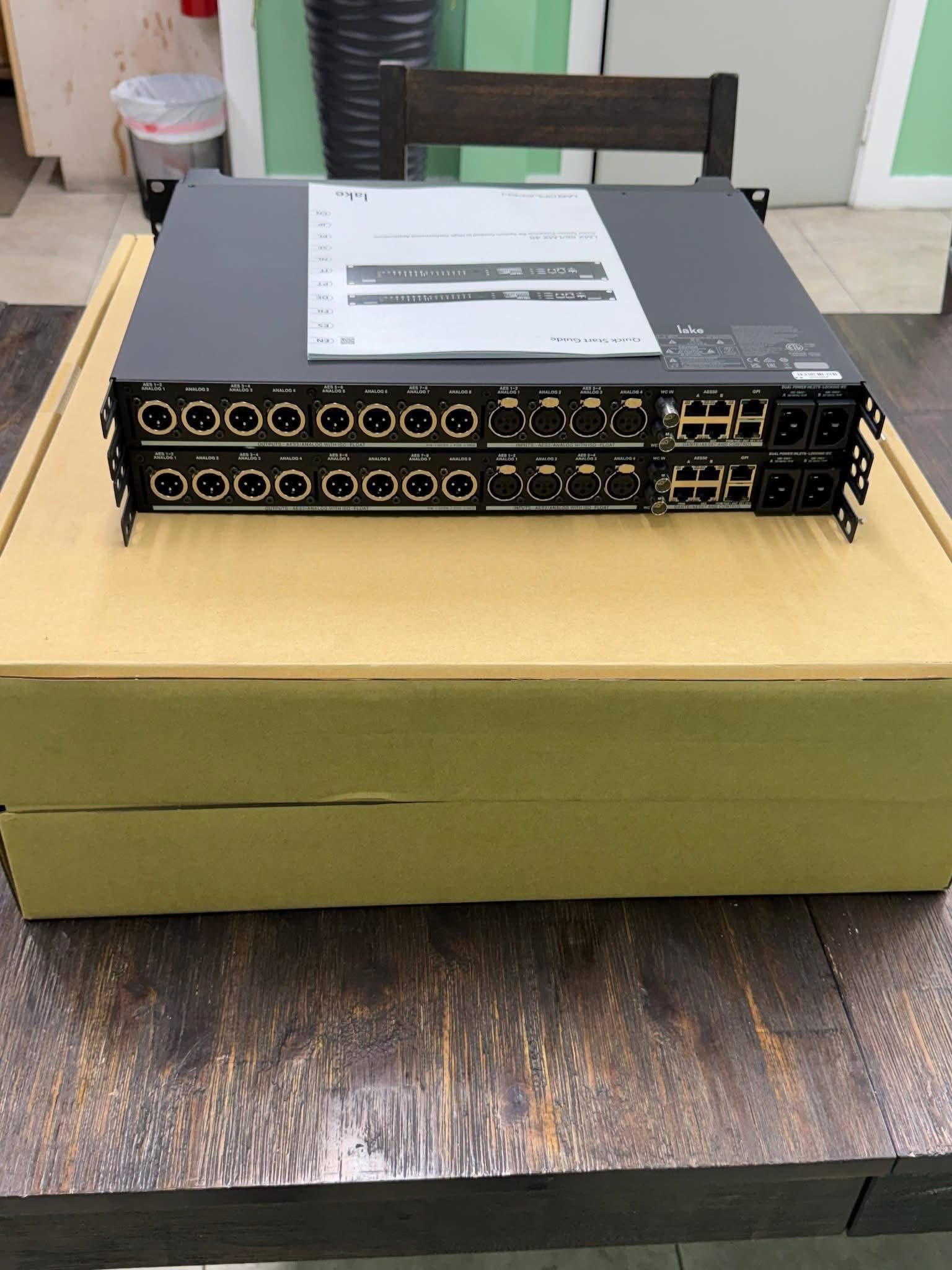
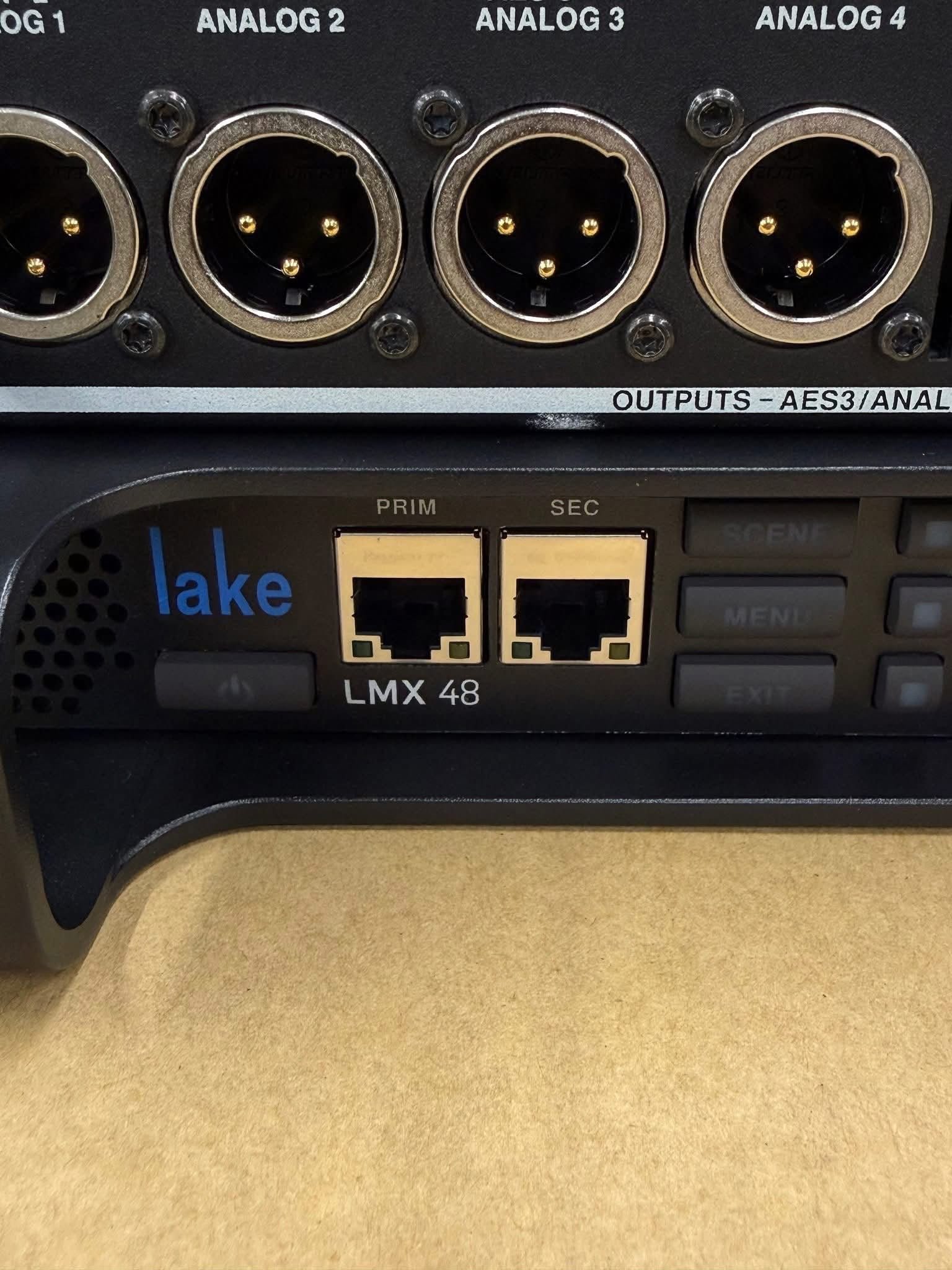
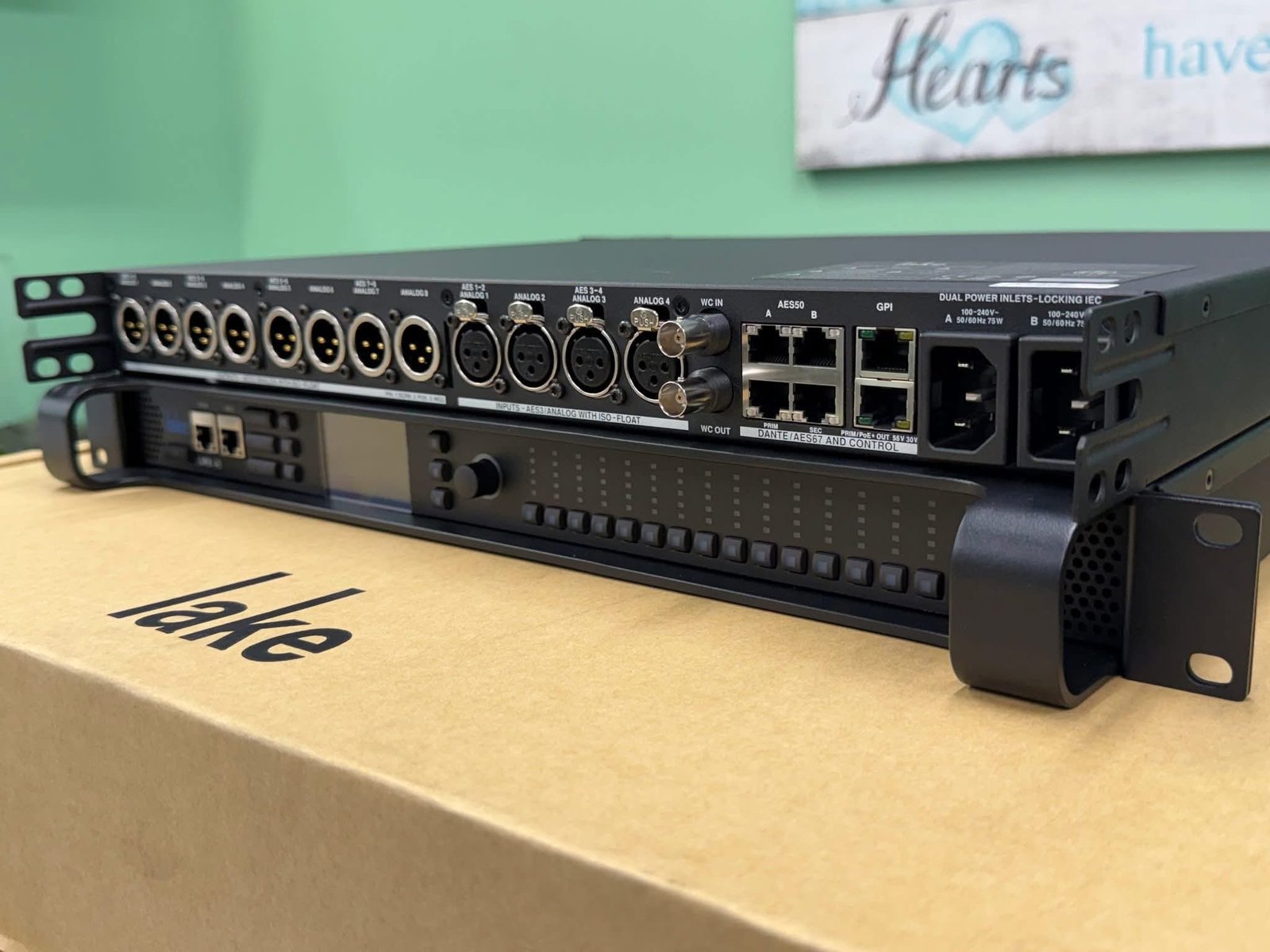
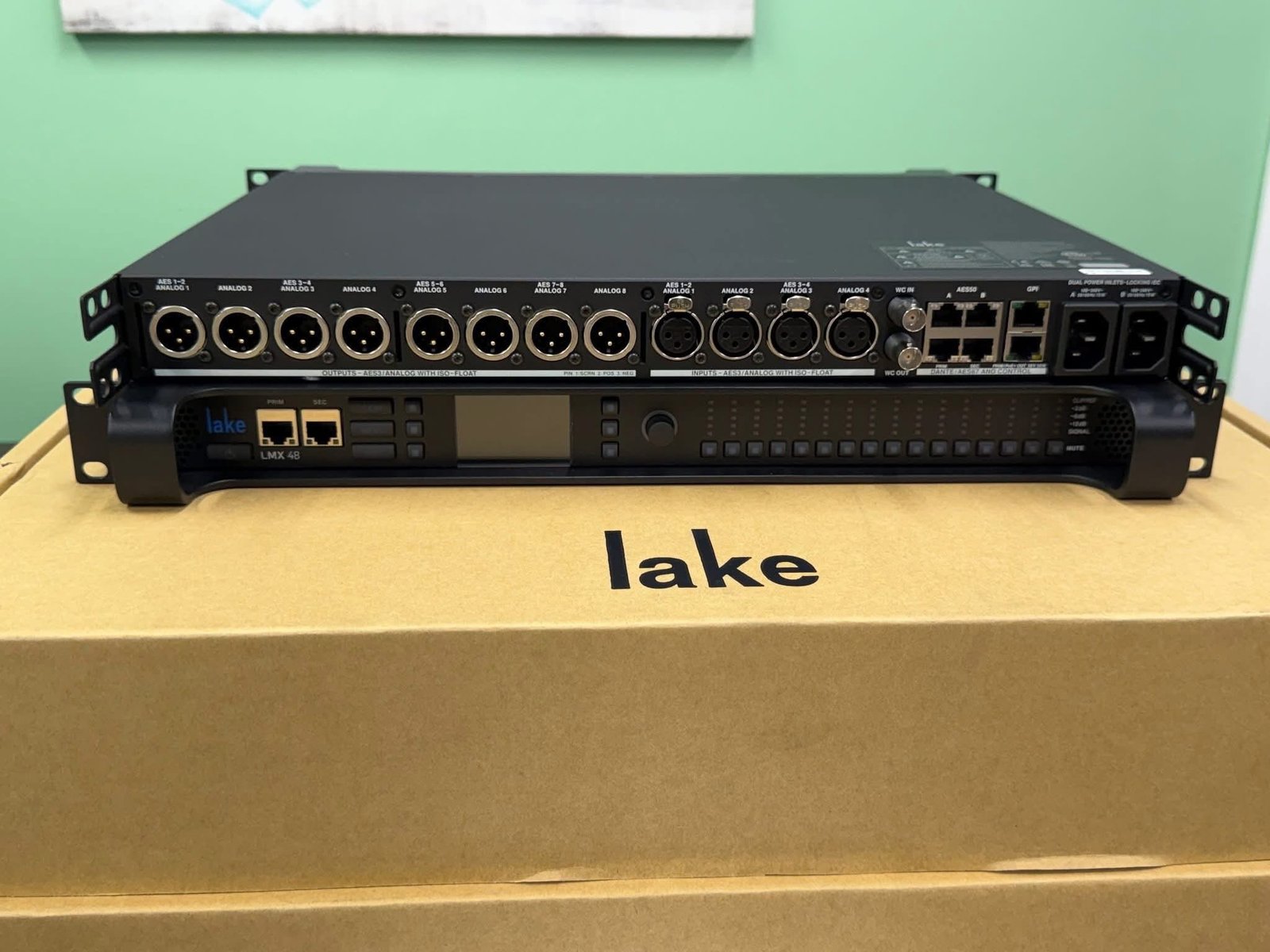
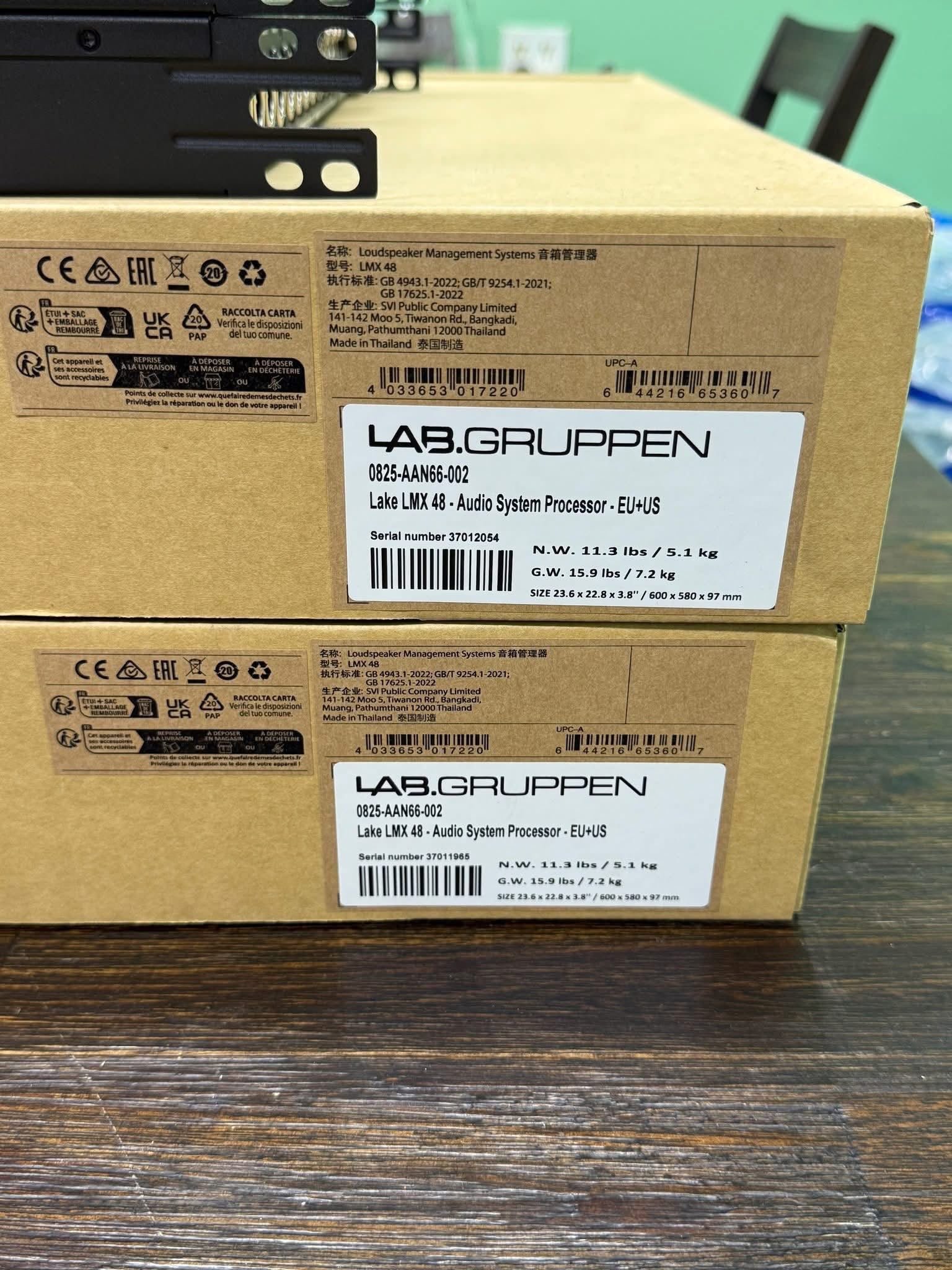
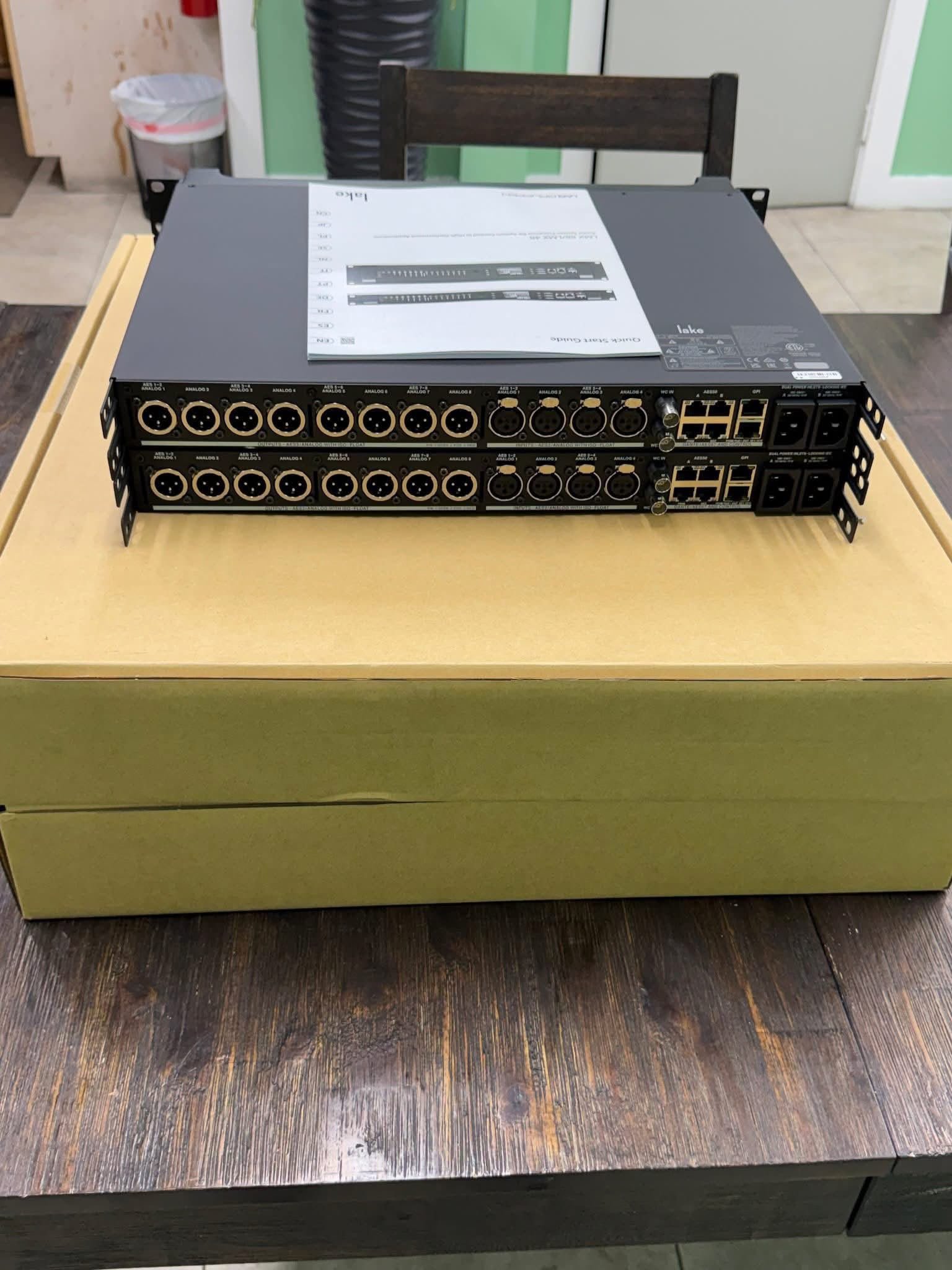
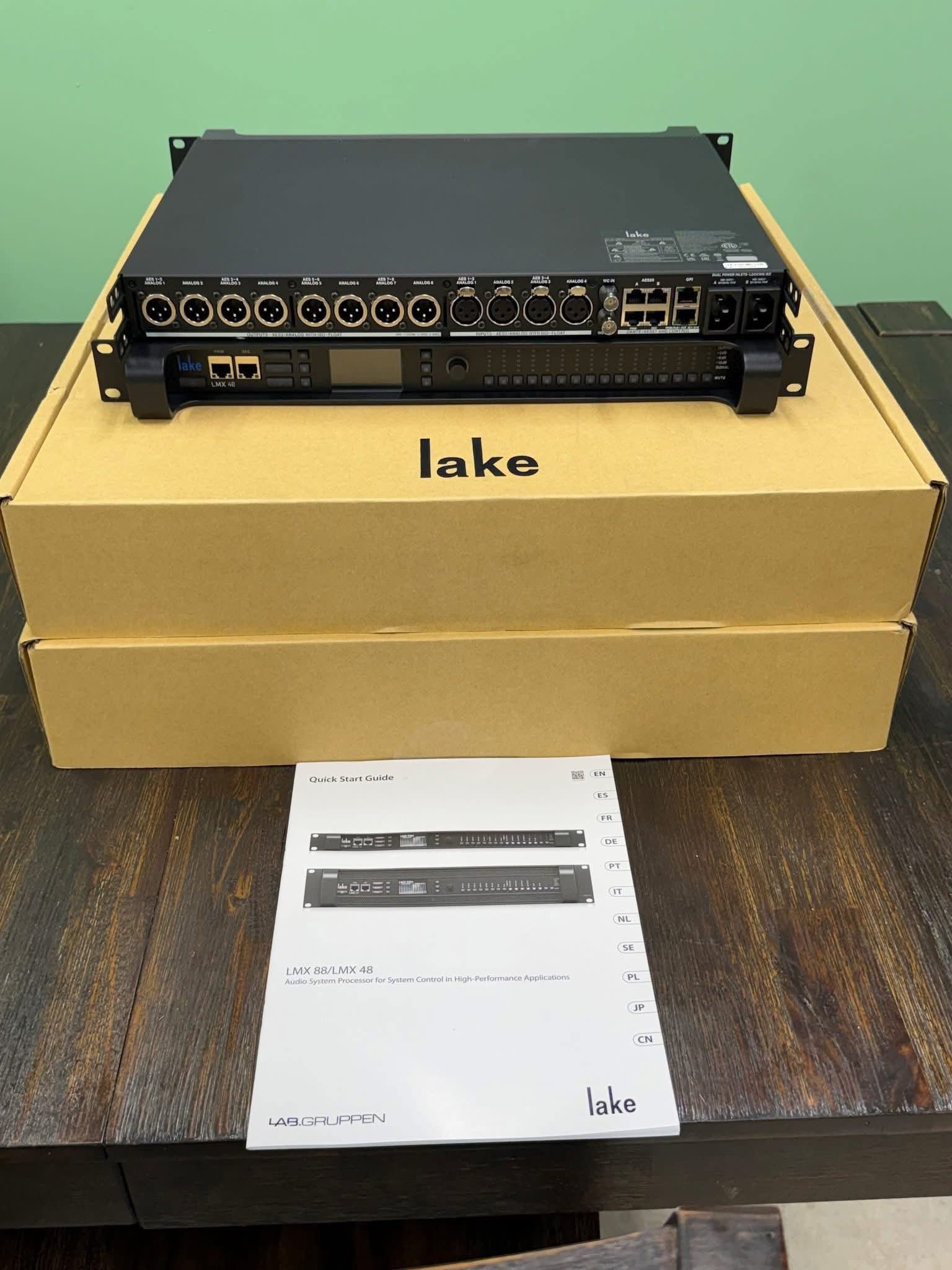


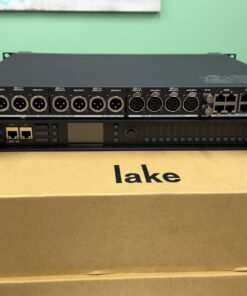



Lake LMX 48 Audio System Processor
Lake LMX 48 is a professional digital audio system processor developed for flexible signal routing, loudspeaker management and high-performance sound-system control. It combines Lake processing with analog, AES3, Dante and AES50 connectivity, making it suitable for touring companies, rental inventories, concert venues, theatres, houses of worship, broadcast facilities and permanent professional audio installations.
The processor can receive signals from multiple mixing consoles and distribute those signals to amplifiers, powered speakers, recording systems and other audio destinations. Its routing, processing and redundancy features make it particularly useful for sound systems where reliability and flexible source management are essential.
Sound Pro Tech offers professional audio equipment for customers throughout France and Europe. Contact us to confirm the condition, availability, included accessories, price and delivery options for the offered Lake LMX 48.
Lake LMX 48 Connectivity and System Control
The Lake LMX 48 provides an extensive collection of analog and digital connections. It includes four analog inputs and eight analog outputs, four AES3 input channels, eight AES3 output channels and eight Dante inputs and outputs.
The processor also provides two AES50 interfaces. Up to 24 channels can be selected from the available AES50 streams and used as inputs or outputs. This connectivity allows the unit to work with several professional mixing consoles, amplifier racks and audio networks.
The main connectivity options include:
* 4 × analog inputs
* 8 × analog outputs
* 4 × AES3 digital input channels
* 8 × AES3 digital output channels
* 8 × 8 Dante networked audio channels
* 2 × AES50 interfaces
* Up to 24 selectable AES50 channels
* Primary and secondary network connections
* General-purpose input for external scene control
* Separate AC connections for redundant power supplies
The appropriate connection format depends on the other equipment in the system. Buyers should confirm the available outputs on their mixing console and the input formats accepted by their amplifiers or powered loudspeakers.
Flexible Input Routing
The Lake LMX 48 includes 16 input routers. Each router can be configured with up to four source priorities, allowing engineers to prepare primary and backup signal paths.
For example, a system can use the main digital console as its first-priority source and a secondary console as its backup. If the primary source becomes unavailable, the processor can move to the next configured source according to the programmed priority.
Input routing can be used for:
* Main and backup mixing consoles
* Festival console switching
* Guest-console integration
* Playback-system redundancy
* Broadcast feeds
* Emergency announcement sources
* Recording-system outputs
* Analog and digital backup connections
A clear input plan should be created before programming the processor. Every source should be labelled accurately so that another engineer can understand the system without having to trace every cable.
Scene Recall and Console Switching
Scenes allow engineers to save and recall prepared signal-routing configurations. A scene can contain a specific combination of inputs, outputs and routing choices for a particular event or operating mode.
This feature is useful for venues that regularly change between different productions. A theatre could create separate scenes for live music, presentations, rehearsals and guest productions. A rental company could prepare scenes for different loudspeaker packages or console arrangements.
Scenes can be recalled through the front panel or Lake Controller software. The general-purpose input on the rear panel can also be configured to activate a scene using a suitable external switch.
Engineers should test every scene before using it during a live event. Scene names should clearly explain their purpose, and configuration backups should be retained on an authorised computer.
Lake Processing Modes
The processor supports Mesa, Contour and hybrid processing configurations. Each mode provides a different combination of processing modules and outputs.
Mesa Mode
Mesa mode provides eight processing modules and eight processing outputs. It is suitable for applications that require flexible system equalisation, routing and output management.
Contour Mode
Contour mode provides four modules and up to 12 processing outputs. It can be selected for systems requiring more complex loudspeaker crossover and output arrangements.
Hybrid Mode
Hybrid mode combines two Contour modules with four Mesa modules, providing up to 10 processing outputs. This arrangement can be helpful when the system requires both loudspeaker crossover processing and general-purpose signal control.
Processing capacity should not be confused with the number of physical analog outputs. The selected operating mode and connection format determine how processed signals are distributed.
Professional Lake Processing
The Lake LMX 48 provides the processing tools required to organise and optimise professional sound systems. Available functions include equalisation, crossovers, delay, gain adjustment, polarity management and limiting.
These tools can be used to manage:
* Main left and right arrays
* Subwoofer systems
* Front-fill speakers
* Side-fill speakers
* Delay towers
* Balcony speakers
* VIP or overflow zones
* Recording feeds
* Broadcast feeds
* Lobby and backstage systems
Settings should be based on the requirements of the actual loudspeakers and amplifiers. A processor should not be programmed using generic values when manufacturer-approved presets or technical data are available.
Some professional amplifier platforms contain their own essential loudspeaker presets and protection. Adding the Lake LMX 48 does not automatically eliminate the need for those amplifier settings.
Dante Networked Audio
Dante connectivity allows compatible audio devices to exchange digital signals over an Ethernet network. The Lake LMX 48 provides eight Dante inputs and eight Dante outputs.
A correctly designed Dante network can reduce the quantity of individual analog cables required between equipment racks. It can also make routing between compatible consoles, processors and recording systems more flexible.
The processor supports primary and secondary Dante connections for network redundancy. However, connecting two network cables does not automatically create a redundant system. The network switches, cable routes, addressing and device configuration must also support the intended redundancy arrangement.
Before using Dante, confirm:
* The network topology
* Switch compatibility
* IP-addressing requirements
* Dante Controller settings
* Sample-rate requirements
* Clock leadership
* Primary and secondary network separation
* Cable quality
* Network ownership and access permissions
Network changes should be documented so that the approved configuration can be restored.
AES3 Digital Audio
AES3 provides professional two-channel digital audio transmission over appropriate connections. The Lake LMX 48 includes four AES3 input channels and eight AES3 output channels.
AES3 can be useful when connecting digital mixing-console outputs to the processor or sending processed digital signals to compatible amplifiers. It avoids unnecessary digital-to-analog and analog-to-digital conversion when the complete signal path supports AES3.
Digital sources may use different clock arrangements. The Lake LMX 48 includes dedicated sample-rate conversion to help integrate multiple nonsynchronised digital sources. Engineers should still verify the sample rates and connection standards used by each device.
AES50 Integration
The processor provides two AES50 interfaces. Up to 24 channels can be selected from the available AES50 streams for use as inputs or outputs.
AES50 can be valuable when integrating compatible professional consoles and stage systems. However, compatibility should be confirmed for every device because identical connectors do not guarantee that different network-audio formats can communicate.
The two AES50 ports can also be used to link two Lake LMX 48 processors so that they can share inputs. This can support larger systems and additional routing requirements.
Redundant Power Supplies
The Lake LMX 48 contains dual internal power supplies with separate AC inlets. This design allows the processor to be connected to two suitable power sources.
For meaningful power redundancy, the two AC inlets should not simply connect to the same unprotected power strip. A system designer should consider independent distribution paths, suitable protection and the venue’s available electrical infrastructure.
The processor can provide a warning when both power supplies are not receiving power. This helps engineers identify a missing or failed power source before it affects system redundancy.
Dual power supplies are especially valuable in:
* Concert touring systems
* Broadcast facilities
* Festival control systems
* Corporate productions
* Theatres
* Houses of worship
* Critical permanent installations
Lake Controller Software
Lake Controller software provides remote configuration, monitoring and control of the processor. Engineers can use it to organise modules, adjust parameters, name sources, create groups and manage system configurations.
Before commissioning the system, confirm that the computer, software and processor firmware are compatible. Maintain a secure backup of the approved configuration before installing updates or making major changes.
Configuration files should include:
* Venue or event name
* Loudspeaker package
* Amplifier arrangement
* Date
* Software version
* Configuration revision
* Name of the responsible technician
Clear file names make it easier to identify the correct configuration when several systems are stored on the same computer.
Dedicated Sample-Rate Conversion
Combining several digital sources can be difficult when they are not synchronised to the same digital clock. The Lake LMX 48 provides dedicated high-performance sample-rate converters for its digital inputs.
These converters allow several nonsynchronised digital sources to be connected more easily. This is helpful for festivals, broadcast environments and venues where visiting consoles may use different clocking arrangements.
Sample-rate conversion does not replace proper system planning. Engineers should still identify the format, sample rate and clock arrangement of every digital device.
Touring and Rental Applications
The Lake LMX 48 can become the central signal-management device in a touring or rental rack. It can receive audio from different consoles and distribute processed signals to several loudspeaker zones.
A rental package should include a clear patch list and configuration reference. Each connector should be labelled so that technicians can prepare the rack quickly and accurately.
Before dispatching a rental system:
1. Inspect the processor.
2. Confirm the correct configuration.
3. Test every required input and output.
4. Inspect power and signal cables.
5. Verify scene recall.
6. Confirm network communication.
7. Back up the configuration.
8. Include the required accessories.
9. Record the equipment’s condition.
10. Provide the technician with the correct documentation.
At the venue, every destination should be tested individually before the complete system is operated at performance level.
Permanent Venue Installations
The processor can also serve as the control centre of a permanent sound installation. It may manage a main system, subwoofers, fills, delay speakers and feeds to secondary areas.
A permanent installation should include documentation explaining:
* Normal startup procedure
* Approved operating scene
* Normal shutdown procedure
* Signal routing
* Amplifier connections
* Network arrangement
* Backup sources
* Authorised configuration access
* Location of configuration files
* Technical support information
Daily users may not need access to every processing parameter. The commissioning engineer can establish a controlled operating routine while keeping advanced settings available to authorised technicians.
System Planning
Before purchasing the Lake LMX 48, create a list of every source and destination in the proposed system.
Sources may include:
* Main mixing console
* Backup mixing console
* Guest console
* Playback system
* Broadcast feed
* Emergency input
* Recording playback
* Networked audio source
Destinations may include:
* Main left array
* Main right array
* Subwoofers
* Front fills
* Side fills
* Delay speakers
* Balcony speakers
* Recording system
* Broadcast system
* Lobby speakers
* Backstage monitoring
Next, determine which destinations require independent processing. Two speaker zones receiving the same programme may still require different delay, equalisation or level settings.
Inspecting a Used Lake LMX 48
When buying a used processor, request photographs of the actual unit instead of relying only on manufacturer images.
Ask for photographs showing:
* Front panel
* Rear connections
* Model label
* Serial number
* Power inlets
* Network ports
* Analog connections
* AES3 connections
* AES50 connections
* Rack ears
* Top and side panels
The inspection should check that the processor starts correctly and that its required connections communicate properly. Cosmetic wear should be described separately from operational condition.
Ask whether the unit has undergone previous repairs or experienced known faults. Confirm whether the current firmware and configuration files will be retained or cleared before delivery.
Included Accessories
Accessories must be listed individually in the quotation. Do not assume that the following items are included:
* Power cables
* Flight case
* Rack
* Network cables
* Analog cables
* AES3 cables
* AES50 cables
* Computer
* Network switch
* Lake Controller software computer
* Wireless router
* Configuration service
* Technical installation
Manufacturer photographs may show equipment that is not included with the used unit.
Why Choose the Lake LMX 48?
The Lake LMX 48 combines several important system-management functions in one professional processor:
1. Flexible analog and digital connectivity
2. Dante networked audio
3. AES3 digital inputs and outputs
4. Dual AES50 interfaces
5. Sixteen input routers
6. Programmable input priorities
7. Scene recall
8. Lake processing
9. Dedicated sample-rate conversion
10. Dual redundant power supplies
These capabilities make it appropriate for complex professional systems that require more than basic crossover processing.
Buying from Sound Pro Tech
Contact Sound Pro Tech with the quantity required and a description of the system you want to control.
Provide the following information:
* Mixing-console model
* Loudspeaker models
* Amplifier models
* Required input formats
* Required output formats
* Number of speaker zones
* Preferred delivery destination
* Required accessories
* Installation requirements
* Desired delivery date
Sound Pro Tech can confirm current availability, unit condition, included accessories, pricing and shipping options for France and other European destinations.
Frequently Asked Questions
Is the Lake LMX 48 a power amplifier?
No. It is an audio system processor. Passive loudspeakers still require suitable power amplifiers.
Does the Lake LMX 48 include Dante?
Yes. It provides eight Dante inputs and eight Dante outputs with primary and secondary network connections.
Does it support AES50?
Yes. The processor includes two AES50 interfaces and can select up to 24 AES50 channels for use as inputs or outputs.
How many analog connections are provided?
The unit provides four analog inputs and eight analog outputs.
Can it receive signals from multiple mixing consoles?
Yes. Its routing and scene functions allow signals from multiple consoles to be organised and distributed. The exact configuration must be programmed and tested before use.
Does it have redundant power supplies?
Yes. It contains two internal power supplies with separate AC inlets.
Can it switch automatically to a backup source?
The 16 input routers provide configurable source priorities for redundant input operation. The complete failover arrangement must be programmed and tested.
Can it be used with powered loudspeakers?
It may be connected to compatible powered loudspeakers, provided their input requirements and internal processing are respected.
Are a rack and flight case included?
Only when specifically identified in the product listing or written quotation.
Is Lake Controller required?
Lake Controller is used for detailed configuration and remote management. Confirm software and firmware compatibility before commissioning the system.
Can ship throughout Europe?
Delivery can be arranged to France and other European destinations, subject to availability and a confirmed freight quotation.
Request a Lake LMX 48 Quotation
The Lake LMX 48 provides professional routing, signal redundancy and Lake loudspeaker processing for demanding touring, rental and installation systems.
Contact https://soundprotech.shop/ to request:
* Current availability
* Actual product photographs
* Serial-number information
* Condition report
* Included accessories
* Current price
* VAT information
* Delivery quotation
* Configuration assistance
Include your delivery country, postal code and basic system information so that an accurate quotation can be prepared.
https://www.labgruppen.com/en/products/0825-AAN
Be the first to review “Lake LMX 48: 7 Powerful Features for Better Control”
Related products

Complete PA Systems

Speakers & subwoofers
L-Acoustics SB28 Subwoofer – Features, Specifications & Price

Audio Processors


Complete PA Systems



Complete PA Systems
Reviews
There are no reviews yet.